




What Happens After FIRST LEGO League?
The recent announcement that LEGO Education will not renew its partnership with FIRST LEGO League after the 2026–2027 season has left many educators, schools, and program organizers asking the same question:
What happens next?
For over two decades, FIRST LEGO League (FLL) has been more than just a competition.
It has shaped how many schools approach STEM education — from curriculum planning to after-school programs.
Now, with this shift, the uncertainty is real:
- Will FLL continue in a different format?
- What alternatives exist?
- How do we keep our STEM programs running without disruption?
- What should we build toward next?
This isn’t just about replacing a competition.
It’s about rethinking how STEM and AI education programs are structured.
What Are People Actually Concerned About?
From discussions across educator communities, forums, and social posts, the concerns are surprisingly consistent:
1. Continuity
“We’ve built our program around FLL. What do we do now?”
Many schools rely on FLL not just for competition, but for structure — timelines, goals, and progression.
2. Curriculum Gap
“What do we teach without FLL?”
FLL often acts as a framework, even when it’s not designed to be a full curriculum.
3. Student Motivation
“How do we keep students engaged without competitions?”
Competitions create excitement — but they’re not the only way to sustain interest.
4. Long-Term Direction
“What should STEM education actually look like going forward?”
This is the biggest (and most important) question.
The Real Issue: Dependency on a Single Ecosystem
FLL didn’t just provide value —it became the center of many programs. That works… until it changes. This moment reveals something important. Many STEM programs are built around external ecosystems, not internal systems. And when the ecosystem shifts, everything else becomes uncertain.
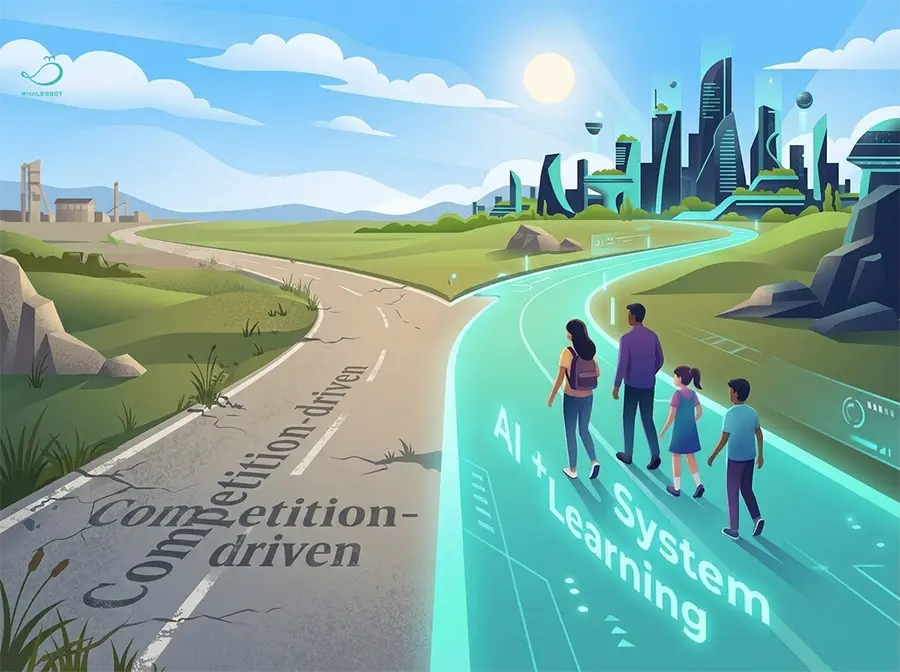
Competition vs. Learning System
Let’s be clear: Competitions like FLL are powerful.
They:
- motivate students
- create visibility
- provide short-term goals
But they are not designed to be full learning systems.
A sustainable STEM or AI education program needs:
- Structured progression (beginner → advanced)
- Tools that work inside classrooms, not just events
- Flexibility across age groups and environments
- Continuity beyond a single season
Without that, programs reset every year.
What Should Schools Do Now?
Instead of asking: “What replaces FLL?” A better question is:“How do we build a program that doesn’t depend on one platform?” Here’s a practical way forward:
Step 1 — Separate Learning from Competition
Think of competitions as application layer not the foundation.Students should be learning continuously, not only preparing for events.
Step 2 — Build a Clear Progression Path
A strong STEM/AI program should include:
- Early-stage: logic, basic coding concepts (screen-free or visual)
- Mid-stage: robotics + problem-solving
- Advanced: AI, automation, real-world application
This progression matters more than any single event.
Step 3 — Use Competitions Strategically
Competitions still matter —
but as:
- milestones
- showcases
- validation of learning
Not the entire program.
Step 4 — Introduce AI Early (This is where things are going)
The next phase of STEM education is already clear: AI is no longer optional. Students today should not only:
- code robots
- but also:
- understand how systems think
- work with data
- explore AI-driven decision making
Programs that ignore this shift will fall behind.
Section 5 — Where STEM Education Is Heading
This transition is bigger than FLL. We’re moving from: Event-driven learning → System-driven learning. From isolated competitions to continuous capability building. From robotics as an activity to robotics + AI as a foundation.
Section 6 — A More Resilient Model (Subtle positioning)
The programs that will succeed moving forward share a few traits:
- They are not dependent on a single ecosystem
- They combine curriculum + tools + real application
- They allow educators to run independently
- They integrate both STEM and AI learning
In this model:
- tools (like robotics platforms) provide the foundation
- initiatives (like competitions) provide engagement\Not the other way around.
Not the other way around
This Is a Reset Moment
The end of a long-standing partnership can feel disruptive. But it’s also a reset. An opportunity to ask:
- Are we building programs that last?
- Are students gaining real capability?
- Are we preparing them for the future of AI-driven technology?
FLL played an important role in inspiring a generation. What comes next is about building what lasts.
How We’re Approaching This at WhalesBot
At WhalesBot, we’ve been working with schools and organizations facing a similar challenge. How to build STEM and AI learning programs that don’t depend on a single platform or competition. Our approach has been to separate two things clearly:
- Foundation — tools, curriculum, and structured learning progression
- Application — competitions, projects, and real-world challenges
This is why we focus on building a system that supports:
- continuous learning from beginner to advanced levels
- both in-class teaching and after-school programs
- integration of robotics and AI learning, not just one or the other
Initiatives like ENJOY AI sit on top of this foundation as a way for students to apply, test, and showcase what they’ve learned. Not as the system itself. Because when external ecosystems shift, the foundation should remain stable.
Thinking About Your Next Step?
If you’re currently re-evaluating your STEM or robotics program after the FLL update, you’re not alone. We’ve been having ongoing conversations with schools and organizations facing the same transition, from competition-led structures to more sustainable learning systems. If you’re exploring what that shift could look like in your context, we’re happy to share what we’re seeing and what’s working.


